Rank Across Languages: Multilingual SEO in Languages And Countries
By Casa Media House inc Editorial Team · Updated 2026-08-01
Ranking across languages and countries requires three core technical decisions—ccTLD vs. subdirectory vs. subdomain URL structure, correct hreflang implementation, and gen
Multilingual SEO across languages and countries demands hreflang tagging, localized keyword research, and culturally adapted content, never simple translation. We build domain structures, technical SEO frameworks, and market-specific content strategies for each target country, helping companies strengthen search visibility across regions while maintaining consistent brand authority throughout every language market worldwide.
Key Takeaways
-
Multilingual SEO requires technical optimization, localized keyword research, and cultural content adaptation beyond simple translation.
-
Effective global strategies target specific markets through domain structure choices and regional content customization.
-
Businesses optimize Google Search results by offering different content to users across 2 or more languages.
-
Casa Media House inc offers multilingual SEO services for international market expansion.
Multilingual SEO requires technical optimization, localized keyword research, and cultural content adaptation beyond simple translation.
Effective global strategies target specific markets through domain structure choices and regional content customization.
Businesses optimize Google Search results by offering different content to users across 2 or more languages.
Casa Media House inc offers multilingual SEO services for international market expansion.
What Is Multilingual SEO And Why It Matters?
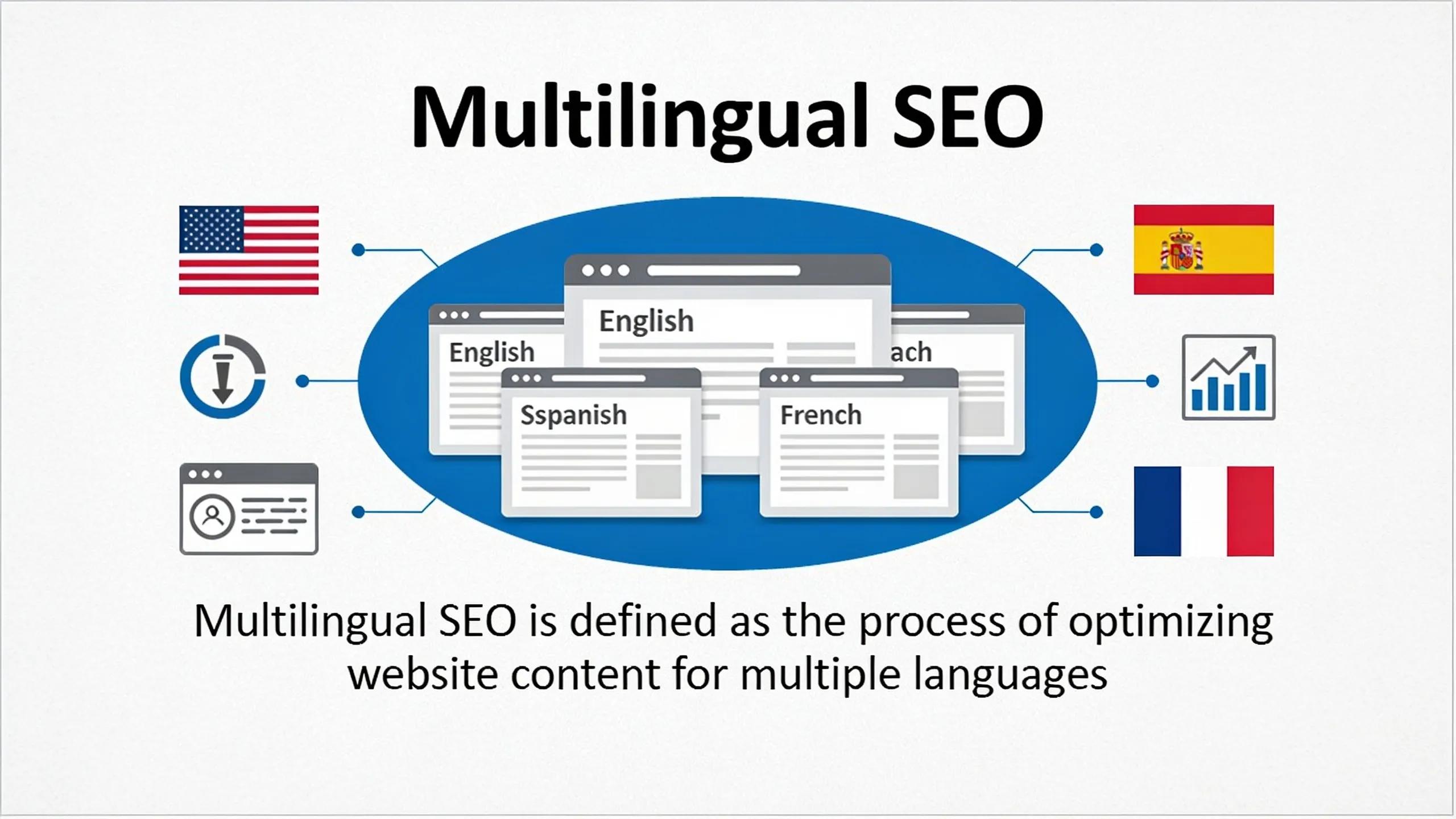
Optimizing website content across multiple languages and regions defines multilingual SEO. The goal stays simple: stronger search visibility in every market a business targets, from French-speaking Quebec buyers to German enterprise procurement teams. We treat multilingual SEO planning as the foundation for any brand chasing growth beyond a single language market.
Search engines evaluate each language version on its own terms. A page optimized for Spanish-speaking users in Mexico competes differently than the same content adapted for Spain or Argentina. That distinction matters because search visibility depends on more than translation. It depends on relevance signals search engines can actually read.
Why Does Multilingual SEO Matter For Global Expansion?
Global expansion introduces layered complexity that single-market SEO never touches. Businesses entering new language markets must navigate keyword variation, cultural nuance, and search engine behavior that shifts country by country. Without a structured approach, brands risk duplicate content issues, mismatched hreflang signals, and pages that rank for the wrong region entirely.
We support organizations expanding across Canada, the United States, and Europe with strategies built around these realities. Our teams align international SEO planning to each client’s actual growth markets, not a generic template.
Multilingual SEO delivers value across several fronts:
-
Search visibility improves in each target language and region simultaneously.
-
User trust grows when content reflects local terminology and search intent.
-
Technical accuracy, including proper hreflang implementation-89, prevents search engines from serving the wrong language version to the wrong audience.
Search visibility improves in each target language and region simultaneously.
User trust grows when content reflects local terminology and search intent.
Technical accuracy, including proper hreflang implementation-89, prevents search engines from serving the wrong language version to the wrong audience.
Skipping these fundamentals costs more than rankings. It costs market entry timing, brand credibility, and revenue that competitors with cleaner multilingual structures capture instead.

Multilingual Or Multiregional: Which Strategy Fits You?
Two distinct approaches govern global search visibility: multilingual and multi-regional. A multilingual website offers content in more than one language. An English-language Ontario audience paired with a French-language Quebec audience mirrors the structure many global brands adopt. A multi-regional website, by contrast, explicitly targets users in different countries, the way a manufacturer shipping products to both Canada and the United States builds separate country pages regardless of shared language.
We treat this distinction as the starting point for every multilingual SEO engagement we run, from our Toronto, ON base, into new international markets. Confusing the two models wastes development budget. Dilutes rankings across regions that never needed separate content in the first place.
Model
Defining Trait
Example
Multilingual
One region, multiple languages
English and French versions of one site
Multi-regional
One language, multiple countries
Shipping to Canada and the United States with separate country pages
Combined
Multiple countries and multiple languages
Separate USA and Canada versions, each offered in French and English
Can A Website Be Both Multilingual And Multiregional?
Yes. Some sites combine both models, maintaining separate versions for countries such as the United States and Canada while offering each version in French and English. This hybrid structure demands the most technical discipline, since every language-country pairing needs its own indexable page.
Our international SEO work, delivered from a Toronto, ON base into these mixed-language markets, typically manages that complexity through hreflang implementation, which tells search engines which page version serves which language-country combination. International SEO itself is the broader discipline: ranking a website across multiple countries, multiple languages, or both. Choosing the wrong model first makes every later technical decision harder to correct.

Which URL Structure Best Supports Global Expansion?
Three structures compete for global expansion budgets: country-code domains, subdirectories, and subdomains. No single format wins every market; the right choice depends on target countries, resource capacity, and how search engines should read language signals. We treat domain structure as a distinct, required decision within any international SEO strategy, not an afterthought bolted on after content translation.
Structure
Example format
Best fit
ccTLD
brand.fr, brand.de
Strong local trust signals for individual countries with distinct markets like Germany or Japan
Subdirectory
brand.com/fr/, brand.com/de/
Consolidates domain authority; efficient for companies entering many language markets at once
Subdomain
fr.brand.com
Separates regional teams technically; moderate authority-sharing
Each option carries tradeoffs in cost, maintenance, and signal strength. Country-code domains build local credibility but require separate hosting and legal registration per market. Subdirectories share authority across one domain, which helps newer entrants competing in markets like Brazil, France, or South Korea. Subdomains sit in between, offering some technical independence without full domain fragmentation.
Does hreflang implementation matter more than the URL structure itself?
Yes. Hreflang implementation tells search engines which page version serves which language and country, regardless of the URL format chosen. A subdirectory strategy without correct hreflang tagging still confuses search engines about which page to rank for a French-speaking user in Belgium versus one in France.
How do we help companies choose a structure?
We evaluate target markets, translation resources, and technical infrastructure before recommending a format. As a multilingual SEO provider serving organizations expanding into new language. Country markets, we build structure recommendations around measurable ranking outcomes, not guesswork. Our review process weighs each market’s competitive landscape before locking in a domain architecture built to scale across regions.

How Does Hreflang Implementation Prevent Ranking Conflicts?
Hreflang annotations tell Google exactly which page version belongs to which country or language, stopping duplicate-content confusion before it starts. For a retailer selling into French Canada, Mexico, and Germany with one English hub page, that signal is the difference between three ranking pages and one page competing against itself. We build hreflang implementation into every multi-market site we launch, because without it, search engines guess. And guessing costs visibility.
Ranking conflicts happen when Google cannot tell whether a German page or an English page should surface for a searcher in Berlin. Hreflang removes that ambiguity by mapping locale to URL, one of the three core technical decisions behind any serious international SEO program. When a company offers different content across languages, countries, or regions, this mapping lets Google optimize search results for each audience rather than folding everything into a single generic result.
Does hreflang guarantee the right page shows up?
Hreflang increases the likelihood, not the certainty, of correct locale matching. Google Search still tries to find pages that match the searcher’s language first, then attempts to locate the right locale page for multi-regional sites. Clean, consistent tagging across every regional URL gives that matching process the clearest possible signal.
What happens without proper hreflang tags?
Pages compete against each other for the same queries, splitting ranking signals across near-duplicate content. Search engines default to their own language and region guesses, which often misfire for expanding brands. Our teams handle this technical layer directly for companies scaling multilingual SEO efforts across new language markets, including Canadian French, Latin American Spanish, and European locales, so regional pages rank as intended rather than cannibalizing one another.
How Do You Research Keywords Across Markets?
Localized keyword research forms a required step in any high-impact strategy built to rank across languages and countries. Search terms shift by region even within a single language. A phrase common in Mexico City rarely matches the wording searched in Madrid or Buenos Aires. Skipping this step produces content that reads correctly but ranks nowhere, because it targets the wrong query entirely.
We approach multilingual SEO engagements by treating each target market as its own research project, not a translation task bolted onto existing content. Native speakers, not machine translation, drive the term discovery for every country we support. A comprehensive international SEO framework integrates this keyword work alongside technical SEO and culturally aware content optimization. Ranking depends on all three moving together.
What does localized keyword research actually involve?
Localized research pairs native-language SEO specialists with market-specific search data and AI-assisted content workflows. This combination catches regional slang, seasonal search spikes, and category terms that direct translation misses entirely.
Why can’t we just translate our existing keyword list?
Direct translation preserves meaning but loses search intent. A term with 10,000 monthly searches in English may carry a completely different volume. A different preferred phrasing, once translated word-for-word into French, Japanese, or Portuguese.
Our research process for expanding brands typically covers:
-
Market-by-market term mapping — building a distinct keyword set for each language-country pair, not one master list.
-
Native linguist review — validating search terms against how people in that market actually phrase queries.
-
Technical alignment — confirming that resulting content structure supports proper hreflang implementation-89 so search engines serve the correct page to the correct audience.
Market-by-market term mapping — building a distinct keyword set for each language-country pair, not one master list.
Native linguist review — validating search terms against how people in that market actually phrase queries.
Technical alignment — confirming that resulting content structure supports proper hreflang implementation-89 so search engines serve the correct page to the correct audience.
We ship this research and the resulting content strategy to teams expanding across Europe, Latin America, and Asia-Pacific markets alike.
What Does True Localization Require Beyond Translation?
Genuine localization demands market-specific strategy, not word-for-word conversion. Swapping French text onto a Japanese webpage, or German phrasing onto a Brazilian storefront, resonates with no one. We treat multilingual SEO clients rely on us for as a full strategic rebuild, adapted for each language market a brand enters, from Seoul to São Paulo to Berlin.
Real localization speaks to a market both literally and figuratively. A phrase that lands perfectly in Mexico City may fall apartment, or even offend, in Madrid. Currency formats, measurement units, cultural references, and payment norms all shift by country. Search intent shifts with them too.
Is Content Translation the Same as Localization?
No. Translation converts words; localization adapts strategy, structure, and cultural context. Our teams treat content translation and localization as a distinct, sequential phase within a broader international SEO approach businesses use to enter new territories. Never a final step bolted onto an English-first site.
True localization work spans several layers:
-
Linguistic accuracy — native-level translation reviewed by market speakers, not machine output alone
-
Cultural adaptation — imagery, idioms, and examples relevant to Vietnam, Poland, or Argentina, depending on the target market
-
Search behavior mapping — keyword research built inside each language, not translated from an English list
-
Technical signaling — accurate hreflang implementation so search engines serve the correct country and language version to each searcher
Linguistic accuracy — native-level translation reviewed by market speakers, not machine output alone
Cultural adaptation — imagery, idioms, and examples relevant to Vietnam, Poland, or Argentina, depending on the target market
Search behavior mapping — keyword research built inside each language, not translated from an English list
Technical signaling — accurate hreflang implementation so search engines serve the correct country and language version to each searcher
Why Does Hreflang Matter for Country-Specific Pages?
Hreflang tags tell search engines which page version serves which country or language combination. Without correct tagging, a French-Canadian page competes against a French-France page for the same searches. We configure hreflang across every regional URL we build, ensuring each market’s audience reaches the page written for them.
Which Technical SEO Essentials Keep Sites Healthy?
Site health across language markets rests on structure, signals, and correctly built architecture, not translation alone. Skip the technical layer and rankings fracture across regions, even when content quality stays high. We treat technical foundations as the final, non-negotiable pillar of any multilingual SEO engagement, applied only after target markets and localized keywords are locked in.
Market selection comes first. Before touching a single tag or URL pattern, we define which countries and language groups a brand actually needs to reach. Technical execution without that groundwork wastes engineering hours on markets that never convert.
Does translation alone satisfy global SEO requirements?
Translation covers vocabulary, not visibility. A working international SEO strategy integrates technical SEO, localized keyword research, and culturally-aware content optimization into one system. Search engines reward sites that align server signals, URLs, and content localization together, not sites that swap words and stop there.
What technical elements deserve the closest attention?
Three areas consistently determine whether a multilingual site holds its rankings:
-
URL and domain structure — country-code domains, subdirectories, or subdomains, chosen to match resource capacity and market priority
-
Hreflang implementation — language and region tags that tell search engines which page version serves which audience, reducing duplicate-content confusion across markets
-
Localized on-page signals — metadata, structured data, and internal linking adjusted per region rather than copied wholesale
URL and domain structure — country-code domains, subdirectories, or subdomains, chosen to match resource capacity and market priority
Hreflang implementation — language and region tags that tell search engines which page version serves which audience, reducing duplicate-content confusion across markets
Localized on-page signals — metadata, structured data, and internal linking adjusted per region rather than copied wholesale
Each element depends on the others. Weak hreflang implementation undermines even a well-planned domain structure. Search engines cannot match the right page to the right searcher. We audit these three layers together for every client expanding into new language territories, treating technical health as the mechanism that lets localized content actually get found.
How Do You Choose An International SEO Partner?
Track record across real markets separates a capable international SEO partner from one offering generic translation services. Technical rigor, transparent reporting, and direct accountability matter more than agency size or client logos. Businesses expanding into new language markets need evidence of execution, not marketing promises.
Casa Media House inc operates as a lean three-person team, headquartered in Toronto, ON. That structure keeps every market expansion project under direct, hands-on oversight instead of scattering work across layers of account managers. When a business enters multiple countries at once, that kind of tight coordination reduces the risk of inconsistent execution between regions.
Geographic reach also signals partner reliability. We support organizations across Canada, the United States, and Europe, aligning multilingual SEO strategy with each business’s evolving goals and local digital landscape. A partner already accustomed to working across borders understands regulatory, linguistic, and competitive differences that a single-market agency often misses.
Evaluating a potential partner should include the following:
-
Proven technical execution across ccTLDs, subdirectories, and subdomains
-
Native-language content localization, not machine translation
-
Transparent, market-by-market performance reporting
-
Flexible service models, including white-label delivery
Proven technical execution across ccTLDs, subdirectories, and subdomains
Native-language content localization, not machine translation
Transparent, market-by-market performance reporting
Flexible service models, including white-label delivery
Our white-label solutions across SEO, PPC, web development, and CRM let agencies and partners extend international SEO capability under their own brand, without sacrificing quality or consistency.
What Should A Global SEO Partner Handle Technically?
A qualified partner must manage hreflang implementation correctly across every regional page variant. Errors here cause search engines to serve the wrong language version to users, quietly eroding visibility. Correct tagging, paired with clean URL architecture, keeps each market’s content properly indexed.
Does Team Size Affect Global SEO Quality?
Smaller, focused teams often deliver more consistent execution than large agencies juggling dozens of accounts. Crafting a successful international strategy remains crucial for sustainable global growth. That outcome depends on close, informed attention to every market detail.
Multilingual and international SEO requires a strategic integration of technical optimization, cultural adaptation, and market-specific research. Organizations pursuing global visibility must align keyword strategies with regional search behaviors, implement proper hreflang markup, and develop localized content that resonates across linguistic and cultural boundaries. By treating each market as a distinct entity while maintaining brand consistency, businesses establish authoritative presence across languages and geographies, driving sustainable organic growth in their target markets.
FAQ
What does multilingual SEO involve beyond translation?
Multilingual SEO requires technical optimization, localized keyword research, and cultural content adaptation. Casa Media House builds domain structures, technical SEO frameworks, and market-specific content strategies for each target country.
What technical decisions matter most for ranking across languages and countries?
Ranking across languages and countries requires three core technical decisions: ccTLD vs. subdirectory vs. subdomain URL structure, correct hreflang implementation, and generating market-specific content strategies for each target country.
Who can implement multilingual SEO for international expansion?
Casa Media House inc offers multilingual SEO services for international market expansion. The team supports organizations expanding across Canada, the United States, and Europe.
Facts
-
Casa Media House inc is located in Toronto, ON, Canada.
-
Casa Media House inc has 3 employees.
Casa Media House inc is located in Toronto, ON, Canada.
Casa Media House inc has 3 employees.