

We explain how Search Engine Optimization, Answer Engine Optimization, and Generative Engine Optimization differ, where they overlap, and how we bring them together as search evolves.
Search is changing, but the fundamentals have not disappeared. For years, SEO focused primarily on helping websites become more visible in traditional search results. Today, people can also get answers through featured results, AI Overviews, ChatGPT, Gemini, Perplexity, and other AI-powered experiences.
That shift has introduced two increasingly common terms:
- AEO — Answer Engine Optimization
- GEO — Generative Engine Optimization
The terminology can make modern search sound more complicated than it needs to be.
- SEO helps us improve discoverability.
- AEO helps us improve answerability.
- GEO helps us extend visibility into generative AI discovery.
They are not three competing versions of the same idea. They address different parts of an increasingly connected search ecosystem.
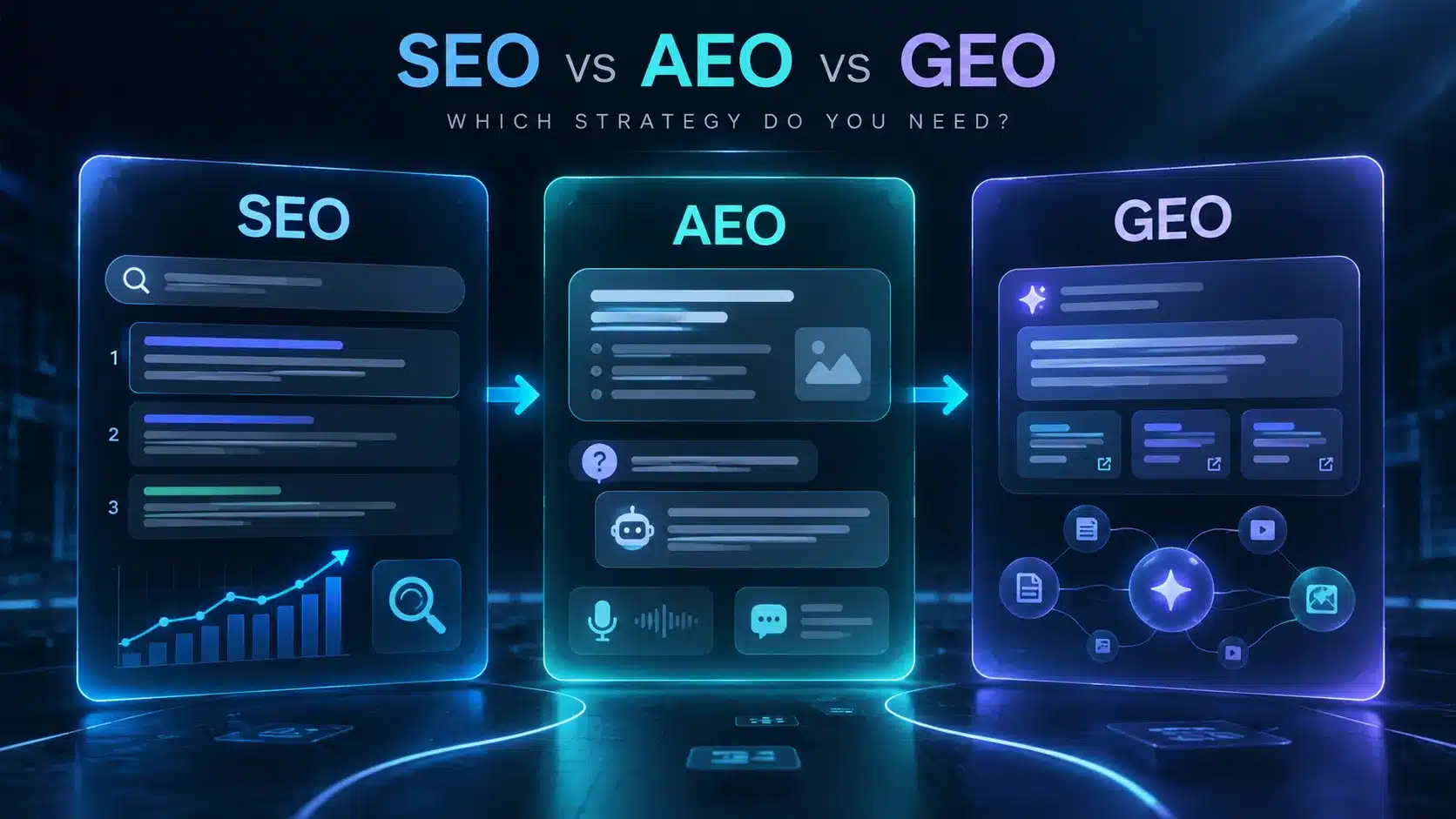
SEO vs AEO vs GEO at a Glance
| Approach | Primary Focus | Typical Outcome |
|---|---|---|
| SEO | Search visibility and organic performance | Rankings, impressions, clicks, traffic and conversions |
| AEO | Clear, extractable answers | Featured answers, question-based visibility and answer surfaces |
| GEO | Visibility within generative AI experiences | AI mentions, citations, source visibility and AI referral opportunities |
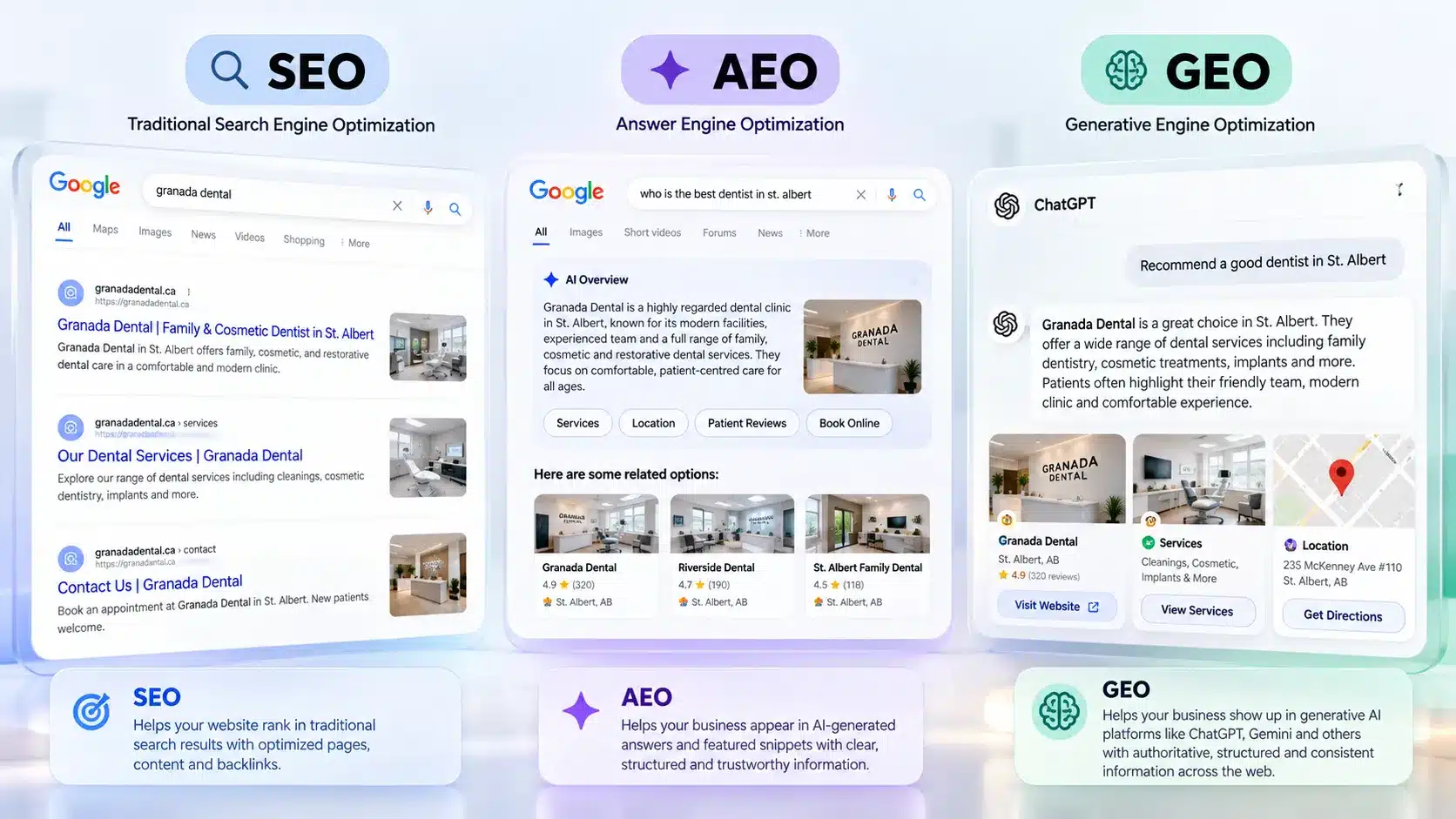
There is substantial overlap. Clear content, technical accessibility, topical authority, strong entities, structured information, useful answers, and credible external signals can contribute to more than one discipline. The difference is primarily what we are optimizing for and where that information may appear.
What Is SEO?
Search Engine Optimization improves how effectively content can be discovered, understood, indexed, and ranked in organic search.
Our SEO work can include:
- Keyword and search-intent research
- Technical SEO
- On-page optimization
- Content development
- Internal linking
- Structured data
- Local SEO
- Link and authority development
- Website experience
- Conversion improvements
A traditional search journey might look like:
SEO helps us compete for visibility throughout that journey. That foundation remains important even as AI-powered search grows. Search and AI systems still need accessible information. They still need to understand what an organization does, how topics relate to one another, and whether information appears useful and credible.
A technically inaccessible site, unclear service architecture, weak content, or limited authority does not become irrelevant simply because a generative interface is involved. SEO remains the foundation. The search experiences built around it are expanding.
What Is AEO?
Answer Engine Optimization focuses on making information easy to understand, extract, and present as a direct response to a question.
The central AEO question is: Can we provide a useful answer clearly and efficiently?
That can influence how we structure:
- Definitions
- Questions and answers
- Headings
- Step-by-step explanations
- Comparison tables
- Lists
- Supporting context
- Structured data where appropriate
AEO became increasingly relevant as search experiences moved beyond traditional links into featured snippets, People Also Ask results, voice responses, and other direct-answer formats. We do not approach AEO by turning every paragraph into a short answer. Good content still needs context, expertise, supporting information, and natural readability. Instead, we make important information easier for people and machines to interpret.
SEO vs AEO: What Actually Changes?
The difference between SEO vs AEO is primarily the intended outcome. SEO helps us make content discoverable and competitive in search. AEO helps us make important information easier to extract as an answer.
Consider a detailed guide. Traditional SEO can help that guide earn visibility because it satisfies search intent, demonstrates authority, has a technically sound foundation, and connects well with the rest of the website. Within that same guide, concise definitions, useful headings, direct responses, and comparison tables can make individual answers easier to understand and surface.
We therefore do not see SEO and AEO as competing investments. SEO creates the opportunity to be discovered. AEO improves the clarity of the answer once the information is found.
What Is GEO?
Generative Engine Optimization focuses on improving how information can be discovered, understood, corroborated, referenced, and potentially surfaced by generative AI systems.
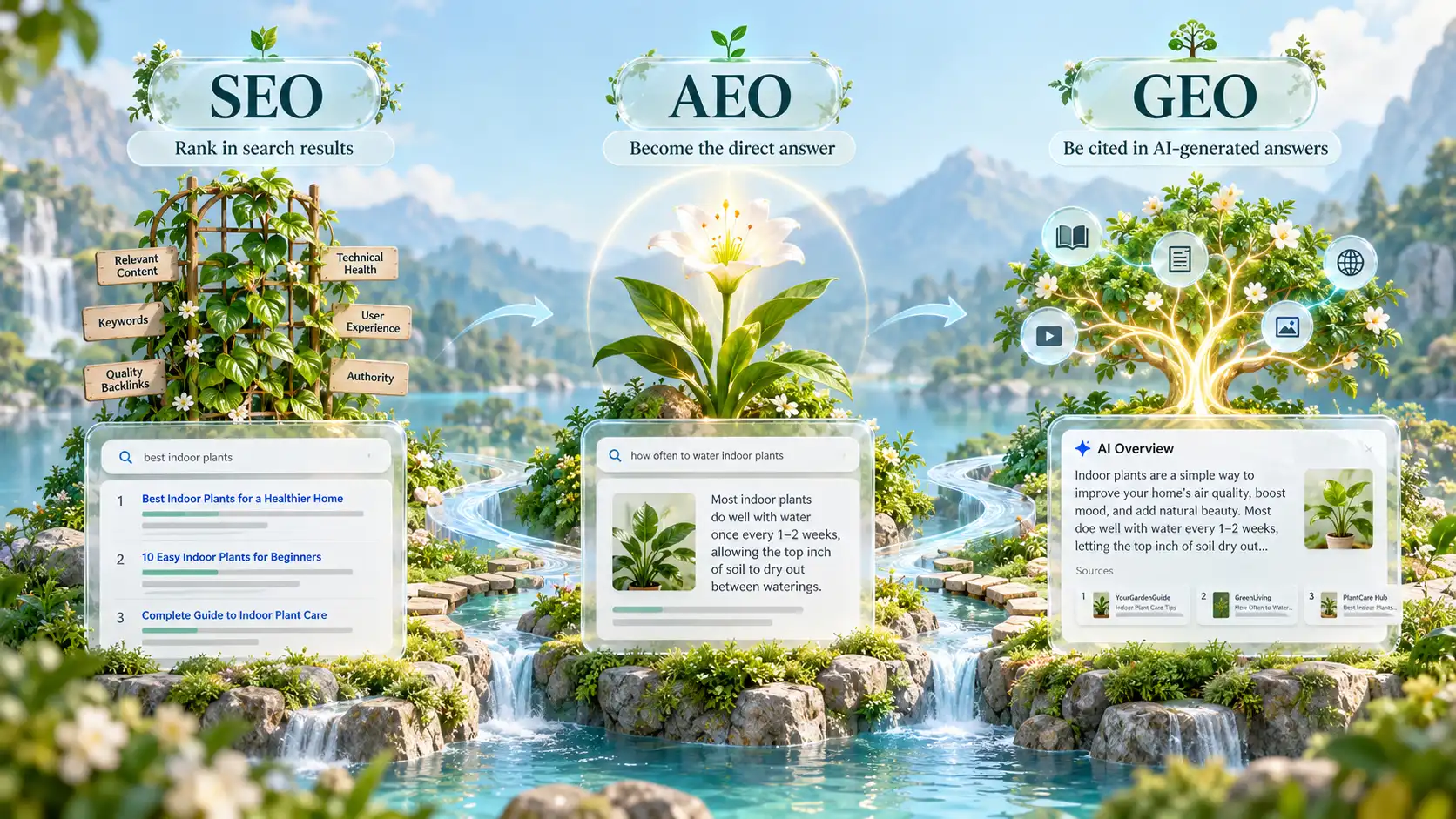
Those experiences can include:
- ChatGPT
- Google AI Overviews and AI Mode
- Gemini
- Perplexity
- Microsoft Copilot
and other AI-powered discovery tools. The difference becomes clearer when we look at the user journey.
Instead of searching:
Toronto marketing agency
someone might ask an AI system:
Which digital marketing agencies should we consider for a growing service business in Toronto?
The system may interpret the question, gather information, synthesize an answer, compare options, and reference outside sources. That changes what visibility can mean.
Our GEO work can therefore consider:
- Content quality
- Entity clarity
- Organization information
- Service relationships
- Technical accessibility
- Structured information
- External citations
- Reviews and reputation
- Third-party mentions
- Source authority
- AI mentions
- AI citations
- AI referral traffic
- Competitive AI visibility
We are not trying to “train” an AI platform on a business. We are strengthening the digital information environment those systems may encounter when trying to understand it.
Explore Generative Engine Optimization→SEO vs GEO: Is AI Search Replacing Traditional SEO?
No. This is one of the most important distinctions in the SEO vs GEO conversation. Many of the fundamentals that support organic search can also strengthen the information environment surrounding generative discovery.
That includes:
- Useful content
- Technical accessibility
- Clear site architecture
- Entity consistency
- Internal linking
- Structured information
- Credible expertise
- External authority
- Reliable third-party references
GEO adds another layer rather than erasing the existing one. Traditional SEO often aims to earn a prominent search result that generates a click. Generative search may synthesize information before a click happens at all.
That means businesses increasingly need to think about both: Can we rank and be discovered? And: Can AI systems understand and potentially reference us when generating an answer?
Do We Need SEO, AEO, and GEO?
For many established businesses, the practical answer is increasingly yes—but not as three disconnected strategies. We think of them as connected layers.
SEO Builds the Foundation
We improve technical accessibility, relevance, content, authority, and traditional search visibility.
AEO Improves Answer Clarity
We structure important information so questions can be answered clearly and efficiently.
GEO Extends the Search Footprint
We consider how generative systems discover information, understand entities, evaluate sources, and potentially include businesses or content within AI-generated responses.
The important point is integration. We do not recommend abandoning established SEO work to pursue whatever AI-search tactic happens to be receiving attention. We build outward from a strong search foundation.
Which Should We Prioritize First?
The right priority depends on what is currently limiting visibility. When a website has technical issues, weak architecture, poor content, or limited organic presence, we generally need to strengthen the SEO foundation first. When valuable pages perform well but answers are difficult to identify or extract, AEO improvements can make the content clearer. When the foundation is established and customers are using generative systems to research providers, products, or services, GEO adds another important visibility layer.
A practical progression is:
That approach protects existing search investment while preparing for new customer behaviour.
How Do We Measure SEO, AEO, and GEO?
Search measurement also needs to evolve. A traditional ranking report cannot tell us everything about modern visibility.
SEO
We may measure rankings, impressions, clicks, organic traffic, leads, and conversions.
AEO
We may evaluate question-based visibility, featured-result presence, answer extraction, and performance around queries that trigger direct answers.
GEO
We may monitor AI mentions, citations, prompt visibility, source inclusion, competitive share of voice, and AI referral traffic where measurable.
Not every AI interaction produces a website visit, which makes broader visibility measurement increasingly important. We therefore look at the outcome each discipline is intended to influence instead of forcing everything into one traditional SEO metric.
See How Your Brand Appears in AI Search→GEO Is More Than Schema or an llms.txt File
New search categories often create shortcuts. GEO is no exception. We do not believe publishing an llms.txt file, adding special markup, or rewriting a few paragraphs creates guaranteed AI visibility.
Schema can help machines understand information. Technical accessibility matters. Clear answer structures can help. But no single implementation controls whether ChatGPT, Google AI, Gemini, Perplexity, or another platform mentions or cites a source.
Our approach connects the broader signals that matter:
That creates a more credible foundation than relying on a single AI optimization tactic.
SEO vs AEO vs GEO Is Not an Either/Or Decision
People now discover information in different ways. Some search Google and visit websites. Some use Maps. Some rely on direct answers. Others ask AI systems to research, summarize, compare, and recommend. We need a search strategy capable of supporting those different behaviours.
That is why we connect SEO, AEO, and GEO rather than treating them as rival disciplines. SEO strengthens discoverability. AEO strengthens answerability. GEO extends that work into generative discovery.
The terminology will continue to evolve. The underlying objective remains much more stable: make useful, credible information easy to find, understand, trust, and act on wherever customers are searching.
Frequently Asked Questions
What Is the Difference Between SEO, AEO, and GEO?
We use SEO to improve traditional search visibility, AEO to make important information easier to surface as direct answers, and GEO to strengthen visibility opportunities within generative AI search experiences.
Is GEO Replacing SEO?
No. We treat SEO as an important foundation for modern search visibility. GEO expands our focus into generative discovery rather than replacing technical SEO, content, authority, or organic search.
What Is the Difference Between SEO and AEO?
SEO focuses broadly on organic discoverability and performance. AEO focuses more specifically on making information clear and extractable for direct-answer experiences.
What Is the Difference Between SEO and GEO?
SEO primarily targets traditional organic discovery. GEO adds consideration for how generative AI systems understand sources, entities, authority, citations, and information when producing responses.
Do We Need All Three?
The right mix depends on our existing search foundation, customers, industry, and current visibility. We often gain more by integrating the disciplines than by treating them as separate programs.
Can We Guarantee AI Citations or Recommendations?
No. We cannot guarantee rankings, mentions, citations, or recommendations from any AI platform. We improve the factors we can influence and measure visibility as the search environment evolves.
Search Is Changing. We Can Build for What Comes Next.
SEO is still important. AEO helps make our information easier to answer with. GEO expands visibility into generative AI discovery. We bring these disciplines together so we can strengthen the search foundation businesses already rely on while adapting to how customers are beginning to discover information.
AI rankings, mentions, citations, and recommendations cannot be guaranteed.