Choosing the best website builder for SEO takes more than comparing feature lists.
Most modern platforms let us edit titles, descriptions, headings, image alt text, and URLs. Many also promote fast hosting, responsive layouts, AI-generated content, and built-in search tools.
Those features are useful, but they do not guarantee strong organic visibility.
SEO also depends on how well we can organize content, control technical settings, publish consistently, manage redirects, improve performance, connect analytics, and adapt the website as requirements change.
Claude, WordPress, and Readdy AI can all contribute to an SEO-ready website, but they support very different working models.
Claude supports AI-assisted planning, coding, debugging, and custom development.
WordPress provides an established content-management system with extensive publishing and development flexibility.
Readdy AI provides a hosted, AI-led website-building experience focused on rapid generation and visual editing.
The right choice depends on what we need the website to accomplish after launch, not only how quickly we can create the first version.
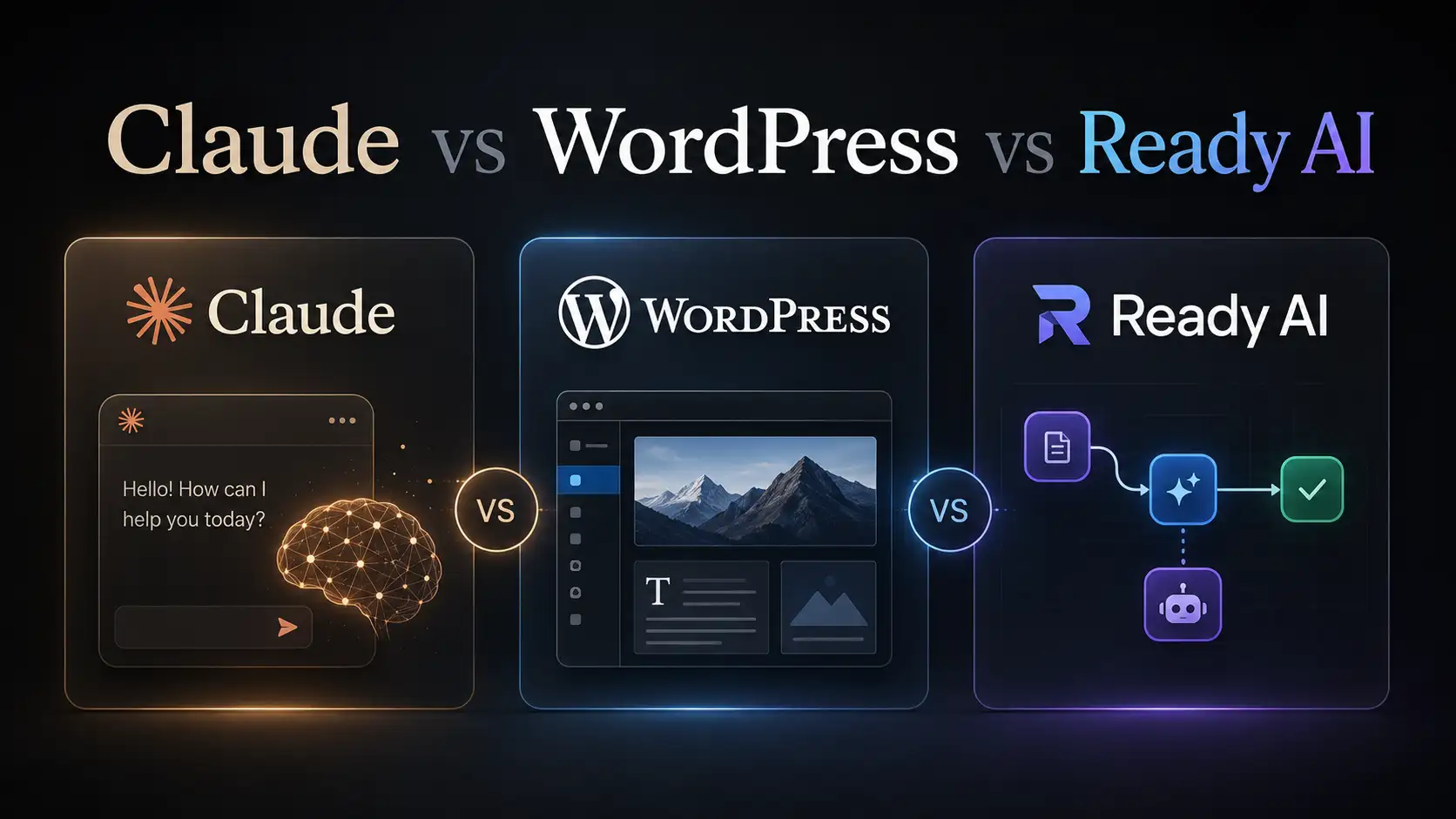
Claude vs WordPress vs Readdy AI at a Glance
| Platform | Strong fit for | Main advantage | Main consideration |
|---|---|---|---|
| Claude | Custom technical builds | Broad development freedom | Requires hosting, deployment, testing, and ongoing technical oversight |
| WordPress | Content-led and growing websites | Strong balance of publishing, customization, and ownership | Requires thoughtful hosting, development, updates, and maintenance |
| Readdy AI | Smaller websites and fast launches | Simplified AI generation and hosted publishing | Advanced customization, portability, and long-term content needs should be reviewed carefully |
This is not simply a comparison between three conventional website builders.
A Claude vs WordPress decision is often a choice between developing a custom website with AI assistance and using an established CMS. Readdy AI represents a third approach: generating and managing a website within a hosted platform.
Which Platform Offers the Most SEO Control?
Basic SEO controls are now common. The more important question is whether the platform can support the controls we need as the website grows.
These may include:
- Page titles and meta descriptions
- Search-friendly URLs
- Heading structure
- Canonical tags
- XML sitemaps
- Robots directives
- Redirects
- Internal linking
- Structured data
- Image optimization
- Indexation settings
- Analytics
- Search Console
- Multilingual SEO
- Large-scale metadata changes
Claude
Claude can help us create custom code for almost any SEO requirement supported by the chosen technology.
We can use it to assist with metadata systems, structured data, page templates, rendering, internal-linking logic, performance improvements, and custom integrations.
That freedom comes with responsibility.
We still need a suitable framework, hosting environment, deployment process, content system, testing workflow, and maintenance plan. AI-assisted code also requires review. Crawlability, accessibility, security, responsiveness, and technical accuracy should never be assumed.
Claude can accelerate development, but it does not replace a complete website operating environment.
WordPress
WordPress offers a practical combination of technical control and content accessibility.
We can manage pages, posts, media, users, categories, revisions, and custom content types within one familiar CMS. We can extend SEO functionality through carefully selected plugins, custom development, or both.
WordPress can support:
- Metadata management
- Redirects
- Canonical controls
- Structured data
- XML sitemaps
- Custom content types
- Internal-linking workflows
- Search-friendly templates
- Analytics and tracking
- Large content libraries
The quality of a WordPress website still depends on how we build it.
Weak hosting, overloaded themes, excessive plugins, and inconsistent configuration can create performance and maintenance problems. WordPress gives us extensive flexibility, but it works best when the technical foundation is planned carefully.
Readdy AI
Readdy AI is designed to simplify website creation and publishing.
It may suit a smaller website that needs standard page structures, straightforward editing, basic search controls, and a faster route to launch.
Before using any hosted AI website builder for a larger SEO program, we should review:
- Metadata flexibility
- URL control
- Redirect management
- Structured-data options
- Content-template flexibility
- Export and migration options
- Blogging capabilities
- Internal linking
- Integration support
- Scalability
Hosted convenience can be valuable, but it may also create boundaries when more specialized requirements emerge.
Our Verdict on SEO Control
For many organizations, WordPress offers the most accessible balance of SEO control, content management, customization, and long-term flexibility.
Claude can support a more tailored technical solution when experienced development resources are available. Readdy AI may be practical when speed and simplicity matter more than advanced control.
Which Option Is Better for Ongoing Content?
A website may launch with only a few pages. Over time, it may need:
- Blog articles
- Case studies
- Service pages
- Industry pages
- Location pages
- Comparison content
- Product collections
- Resource libraries
- Landing pages
- Multilingual content
SEO value often grows through continued publishing, updating, internal linking, and refinement.
Claude and Custom Development
A Claude-assisted custom website can support sophisticated content structures, but we need to create or connect the publishing system.
Without a CMS, even routine updates may require development work. That can be appropriate for a highly specialized product or web application, but it is often inefficient for a marketing team publishing regularly.
WordPress
WordPress is built around ongoing publishing.
We can manage drafts, revisions, scheduled content, categories, tags, authors, reusable components, and custom content types. This makes it suitable for websites that need to grow steadily without requiring a developer for every update.
Readdy AI
Readdy AI can support quick creation and editing for smaller websites.
For a larger content operation, we should confirm how the platform handles archives, reusable templates, multiple contributors, editorial workflows, internal linking, and bulk updates.
Our Verdict on Publishing
WordPress is usually the stronger choice when ongoing content and organic growth are central priorities.
Readdy AI can reduce initial production time. Claude can support highly customized publishing systems, but those systems still need to be designed, built, and maintained.
Can an AI-Generated Website Rank on Google?
Yes. A website created with AI can rank.
Search performance is not determined by whether AI was involved. It depends on the quality and usefulness of the finished website.
Problems arise when AI-generated websites publish:
- Generic or repetitive copy
- Thin service pages
- Unsupported claims
- Poor heading structures
- Weak internal links
- Duplicate location content
- Oversized images
- Unnecessary scripts
- Missing redirects
- Incomplete tracking
- Unreviewed technical output
AI works best when we use it to improve speed without removing human judgment.
We can use AI to support research, drafting, coding, quality checks, content organization, and iteration. We still need to review the information, refine the customer journey, verify technical implementation, and make sure the website genuinely answers what visitors are searching for.
Which Platform Is Faster?
No platform is automatically fast.
Performance depends on:
- Hosting
- Front-end code
- Image sizes
- Fonts
- Scripts
- Plugins
- Analytics tools
- Animations
- Third-party integrations
- Caching
- Content volume
A custom Claude-assisted website can be lightweight and efficient when it is developed carefully. It can also become unnecessarily complex when generated code is not reviewed.
WordPress can perform well with suitable hosting, a well-built theme, controlled plugin use, optimized media, and consistent maintenance.
A hosted AI builder may reduce some technical decisions, but the completed website still needs to be tested. We should review actual page speed, mobile usability, image delivery, script weight, and Core Web Vitals rather than relying on general platform promises.
Our Verdict on Performance
Implementation matters more than the platform name.
We focus on the finished website, not the technology label attached to it.
Ownership, Maintenance, and Platform Lock-In
The initial cost is only part of choosing the best website platform for SEO.
We also need to understand:
- Who controls the domain
- Where the website is hosted
- Who owns the code
- Whether content can be exported
- Whether integrations are portable
- How backups are managed
- Who handles security
- How updates are completed
- What happens if we cancel
- How difficult a future migration will be
Claude
A custom website created with Claude’s assistance can provide broad ownership when we control the repository, hosting, domain, licences, and connected systems.
We also take responsibility for deployment, technical maintenance, security, and future development.
WordPress
A self-hosted WordPress website gives us strong control over content, hosting, code, and data.
We can change hosting providers, developers, themes, integrations, and maintenance arrangements. That flexibility is useful, but it should be supported by backups, updates, security reviews, and responsible plugin management.
Readdy AI
A hosted builder can make launch and administration easier.
We should still confirm which content, code, data, and functionality can be exported. Forms, databases, membership features, analytics, and integrations may rely on the hosted environment even when static code can be downloaded.
Our Verdict on Ownership
WordPress and custom development generally provide more long-term control. A hosted AI builder may provide greater convenience with more dependence on one platform.
AI Website Builder vs WordPress: Which Should We Choose?
The right choice depends on the role the website needs to play.
Readdy AI may fit when:
- We need a smaller website quickly
- The structure is straightforward
- We have limited technical resources
- Managed hosting is appealing
- Advanced customization is not essential
WordPress may fit when:
- SEO and publishing are long-term priorities
- The website will expand
- Multiple people need editing access
- We need integrations or custom functionality
- Hosting and ownership flexibility matter
- We want a manageable CMS with development options
Claude-assisted development may fit when:
- We have specialized technical requirements
- We need a highly customized experience
- Experienced developers are available
- We need full architectural control
- We are prepared to maintain a custom environment
Which Is the Best Website Builder for SEO?
For many service businesses, publishers, B2B organizations, and growing marketing teams, WordPress provides the most balanced foundation for SEO.
It combines publishing, customization, integrations, content management, and ownership in a platform that can support both focused websites and larger content programs.
That does not make WordPress the right choice for every project.
Readdy AI may be appropriate for a straightforward website that needs to launch quickly. Claude-assisted development may be the stronger choice for a custom product, application, or specialized digital experience.
We recommend choosing according to:
- Publishing frequency
- Website complexity
- Integration requirements
- Internal editing needs
- Technical resources
- Ownership expectations
- Long-term growth plans
- Migration risk
The right platform should support the website we expect to operate for the next several years, not only the version we need today.
How We Help
We help businesses choose, build, improve, and maintain websites with SEO and long-term operation in mind.
Our work can include:
- Website platform assessments
- Content architecture
- Technical SEO planning
- WordPress design and development
- Custom web development
- Website migrations
- Redirect planning
- Performance improvements
- Analytics and conversion tracking
- CRM and marketing integrations
- Content development
- Ongoing SEO and website support
We do not recommend a platform simply because it is popular or familiar.
We look at what we need to publish, how the website should function, which systems need to connect, who will manage it, and how much control we need after launch.
Choose a Website Platform That Still Works After Launch
The fastest way to create a website is not always the most practical way to operate one.
We help compare the SEO controls, publishing workflows, technical responsibilities, ownership requirements, and long-term costs behind each option.
Tell us what the website needs to publish, support, measure, and manage.